Semiquincenntenial
A new and weekly series of postings detailing the role of Historical Cortlandt in America!!
In honor of our 250th Anniversary, the Town of Cortlandt is creating a weekly series of postings about historic sites within our town. Cortlandt was founded 12 years after Independence, in 1788. But the original settlers came much earlier, in the 17th century. The Town of Cortlandt played a major part in the fight for freedom and the founding of our country. Each week, we will showcase a different location within Cortlandt, providing the historical significance of each with photographs and descriptions.
PLEASE HELP US…if you know of historically significant areas in your part of town, please let us know! Send us the locations and what you know about them. Provide information and photographs. We will choose one area each week to highlight. Don’t be discouraged if it takes some time for us to post about your area; it is a big town of almost 50 square miles, with a tremendous treasure trove of history. But we have the whole year! Send your suggestions to TOC250@townofcortlandtny.gov.
We are grateful for the input of the Van Cortlandt Historical Society’s Jeff Canning and Hendrick Hudson’s Living History Teacher Joseph Ryan for their professional assistance.
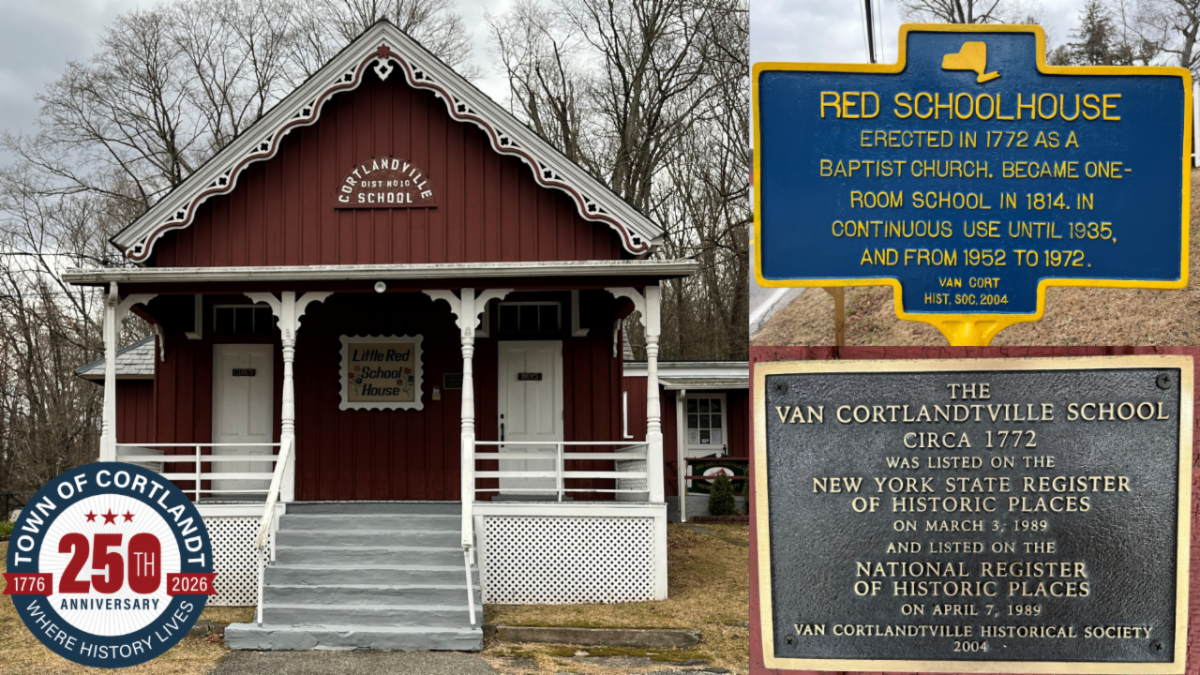
Here's our first posting: The Little Red School House, on Locust Avenue, just south of Oregon Road. It is now the home of the Van Cortlandtville Historical Society.
WHERE HISTORY LIVES PART 1: The Little Red Schoolhouse
The Little Red Schoolhouse was erected in 1772 as a Baptist Church and remained a church until 1814, when it was converted into a one-room school house. It served as a school continuously from 1814 until 1935 , and then again from 1952 thru 1972, serving as a kindergarten-- as part of the Lakeland Central School District. In 1989, it was officially recognized on both the New York State and National Registers of Historic Places. It subsequently became the home and meeting place of The Van Cortlandville Historical Society, which began conducting its Early School Days program at the Schoolhouse in 1975, to enable local fourth graders to experience classroom life in the 1840s. Thus, it provided the rare opportunity for young learners to step into a preserved piece of educational history. The schoolroom and adjoining meeting room of the Society has books, photographs and classroom items dating back to that early era.
WHERE HISTORY LIVES PART 2: KING'S FERRY
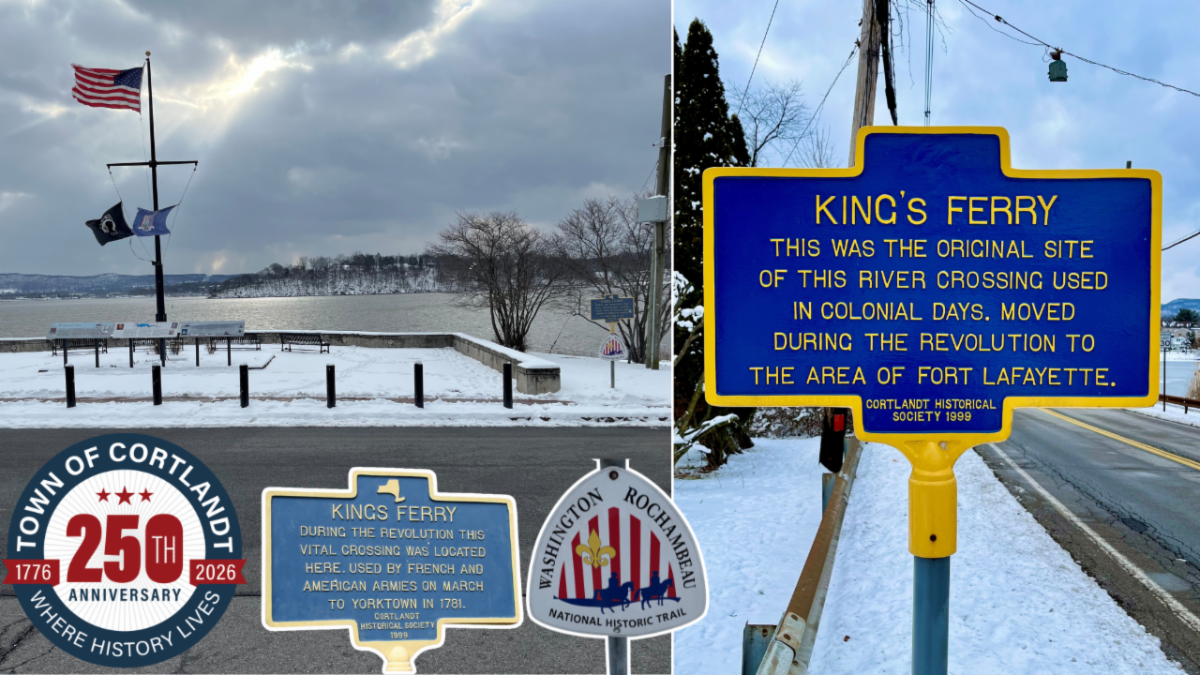
Verplanck was an extremely busy place for several days in August 1781 as American and French soldiers crossed the Hudson River to Stony Point via the King’s Ferry. Two months later those soldiers, with the aid of a French fleet, would deliver a decisive blow against the British in Yorktown, VA, during the fight for the independence of the United States.
Here is the story: During the war troops, arms and supplies from the northern colonies, had to cross the Hudson to fight in the south. King’s Ferry was the key crossing point across the Hudson.
The French army, commanded by the Comte de Rochambeau arrived in Westchester County on July 6, 1781. This massive effort and challenging crossing happened between August 20 and 26, 1781.
This successful crossing of the river, allowed the necessary troops and supplies to head south, that eventually led to the Oct. 19 surrender of Cornwallis at Yorktown, Va.
This helped convince the government in London that pouring additional resources into suppressing the revolution was fruitless.
Re-enactors from the Brigade of the American Revolution camped at Verplanck’s Point Aug. 25-27, 2006, to commemorate the 225th anniversary of the crossing.
A highlight of the weekend was the dedication of a plaque with the following inscription near the water’s edge in Verplanck: “In grateful remembrance. Dedicated to the soldiers of the Continental and French armies who crossed the Hudson River here at King’s Ferry August 20-26, 1781 on their march to victory at Yorktown, Va. May their sacrifices and hardships never be forgotten, the liberty and independence they fought for never be taken for granted and may the spirit of their patriotism burn within our hearts forever. Erected at Verplanck’s Point by the patriotic citizens of the Town of Cortlandt on August 26, 2006 during the 225th anniversary of the American War for Independence.”
WHERE HISTORY LIVES PART 2: Old St. Peter's Church and Old Cemetery
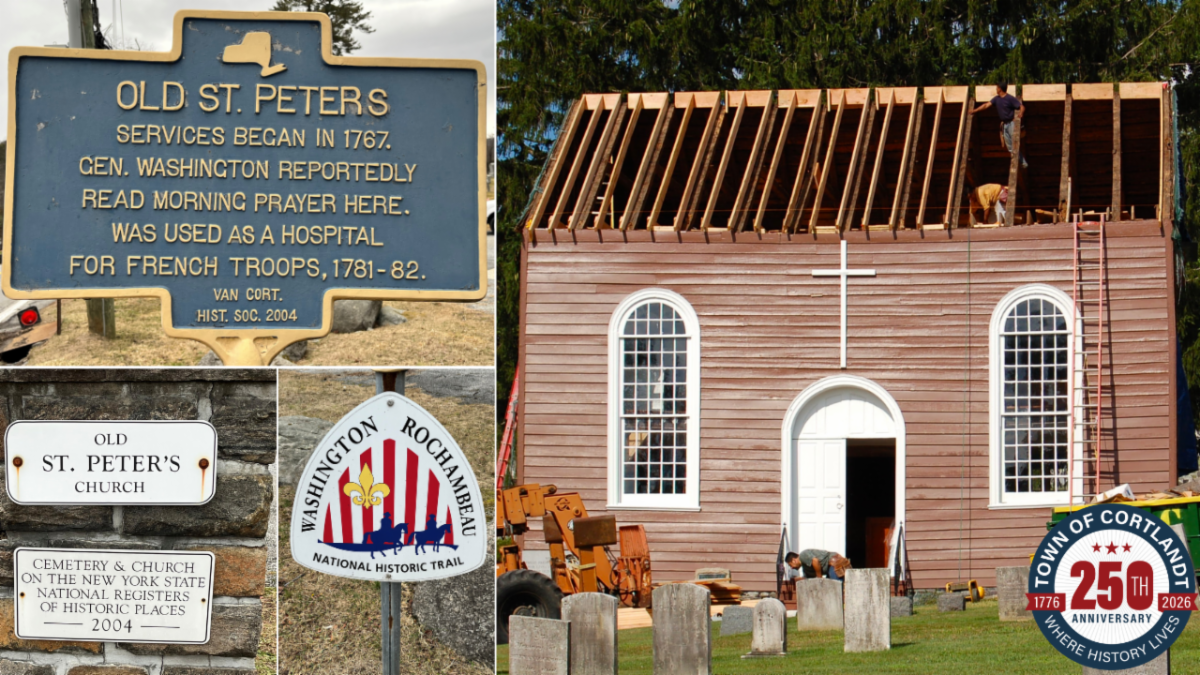
Old St. Peter's Church and Old Cemetery, also known as St. Peter's Church of Cortlandt is a historic Episcopal church and cemetery at Oregon Road and Locust Avenue in Van Cortlandtville, Westchester County, New York. The church was built in 1766 and measures 28 feet by 36 feet. It is a wood-frame building sheathed in clapboards and was restored in 1964.
This cemetery is located at the intersection of Locust Ave and Oregon Road in Cortlandt Manor. There are several historic roadside markers around this old graveyard. Located in the cemetery is a small red clapboard building The Old St Peters Episcopal Church. Services in this building were attended by General George Washington at times when he stayed nearby. This building was also used as an Army Hospital from 1781–1782 by French General Rochambeau before and after The Battle of Yorktown Virginia 1781-2. The property was added to the National Register of Historic Places in 1973 with reference number 73001292. Buried beside the church are unnamed graves of French troops of General Rochambeau and 44 unnamed soldiers of the Revolution. In the churchyard there is an anvil monument dedicated to Major General Seth Pomeroy. The monument is constructed of black granite, is 5' 8" high, and weighs over 6.5 tons. When the American Revolution ended, the great pioneer migration to the West began. The Pomeroy Anvil Trail commemorates the westward migration of the American people through the movement of the Pomeroy family. His burial site in the graveyard is unmarked.
The property was added to the National Register of Historic Places in 1973 with reference number 73001292. The documentation itself, dated 2003, describes one contributing site (the cemetery) and one contributing object, in addition to the already listed one contributing building of the property.
WHERE HISTORY LIVES PART 4: THE VAN CORTLANDTVILLE SKIRMISH OF MARCH 1777
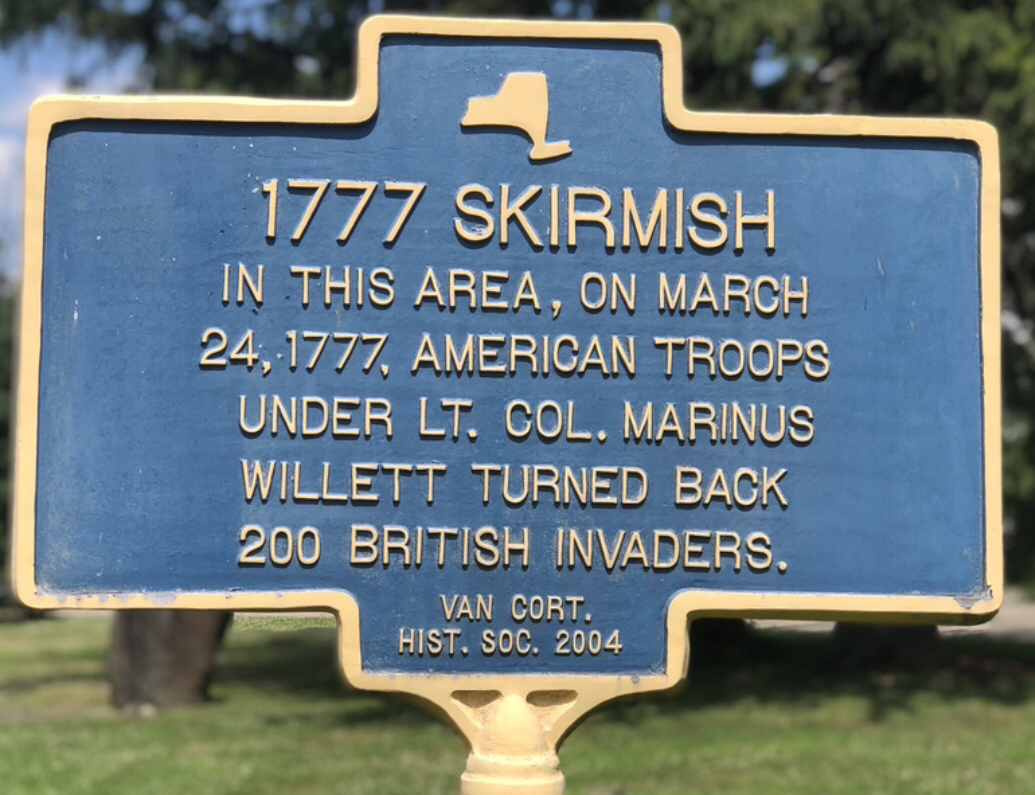
Summary/Overview: The Van Cortlandtville Skirmish was fought on March 24, 1777 between American patriot troops commanded by Lt. Col. Marinus Willett and a British raiding party commanded by Lt. Col. John Bird in modern-day Cortlandt, during the American Revolutionary War. British troops marched up the Post Road (later known as Hillside Avenue and Oregon Road) to the Twin Hills, just south of the Van Cortlandt family’s Upper Manor House, where McDougall had posted an advance guard. The battle ended in American victory, with the British withdrawing back to their boats.
The Details: After being pushed out of New York City in 1776, George Washington established his headquarters in Peekskill along the Hudson River. He considered the area critical for keeping the Continental Army supplied. The British were well-aware, and in late March 1777, 500 British troops sailed up the Hudson River to raid Patriot farms and burn supplies. They landed at Peekskill Bay on March 23 and began pummeling Brig. Gen. Alexander McDougall‘s 250-man force on Fort Hill with artillery. Control of the Hudson River Valley was the linchpin between New England and the more southerly colonies, and the Hudson was the main street of New York. Washington considered this locale so important that it became a major assembly area for troops and militia as well as arms and supplies. The area was critical for the movement of men and materiel up and down the river, east into New England or west and south via the King’s Ferry between nearby Verplanck and Stony Point.
Washington’s worst fears were realized when in early 1777 the British sent a fleet of more than a dozen ships and smaller craft under the command of Col. Bird, to Peekskill, which had been established by Washington the previous November as the command post and headquarters for the Hudson Valley. Bird’s fleet appeared in Peekskill Bay around noon on Sunday, March 23 with 500 men. After burning a house owned by the Lent family the British troops marched up the Post Road and took up positions on Drum Hill, where they began firing at the settlement and the American positions on Fort Hill. Brig. Gen. Alexander McDougall, in charge of the 250-member American Highland Command, outnumbered 2-1, As the 500-man British forces advanced, they destroyed American barracks, workshops and storehouses. On Monday, March 24, the British troops marched up the Post Road (later known as Hillside Avenue and Oregon Road) to the Twin Hills, just south of the Van Cortlandt family’s Upper Manor House, where McDougall had posted an advance guard.
Meanwhile, American Colonial Willett led 80 men to join McDougall at the Gallows Hill barracks. There he observed a British detachment that was separated from the rest of the troops by a ravine, and he implored McDougall to attack them. While other Americans created a diversion to the west, Colonel Willet ordered his 80 men to fix bayonets and attacked the eastern flank of the British. Willett’s troops overwhelmed the British with the unexpected assault, sniping at them from behind trees and stone walls. Aided by darkness the British fled back to Fort Hill. After waiting for the full moon to rise, the entire invasion force retreated to its ships and sailed back to New York the next day. McDougall returned to Peekskill and reoccupied the Fort Hill redoubts and the settlement. Willett’s counterattack left nine British dead and four wounded. Four more British were killed while trying to burn American boats at Canopus Creek The colonel reported two men killed and four or five wounded.
McDougall wrote to George Washington: “…the Enemy fled with great precipitation to the main Body. They were panic struck, asserted the Woods were full of Rebel Soldiers.” The British slipped away in their boats the next morning. A few months later, at Van Cortlandtville, his men provided material for an early version of the U.S. flag, possibly its first use in battle.