Where History Lives: Part 4
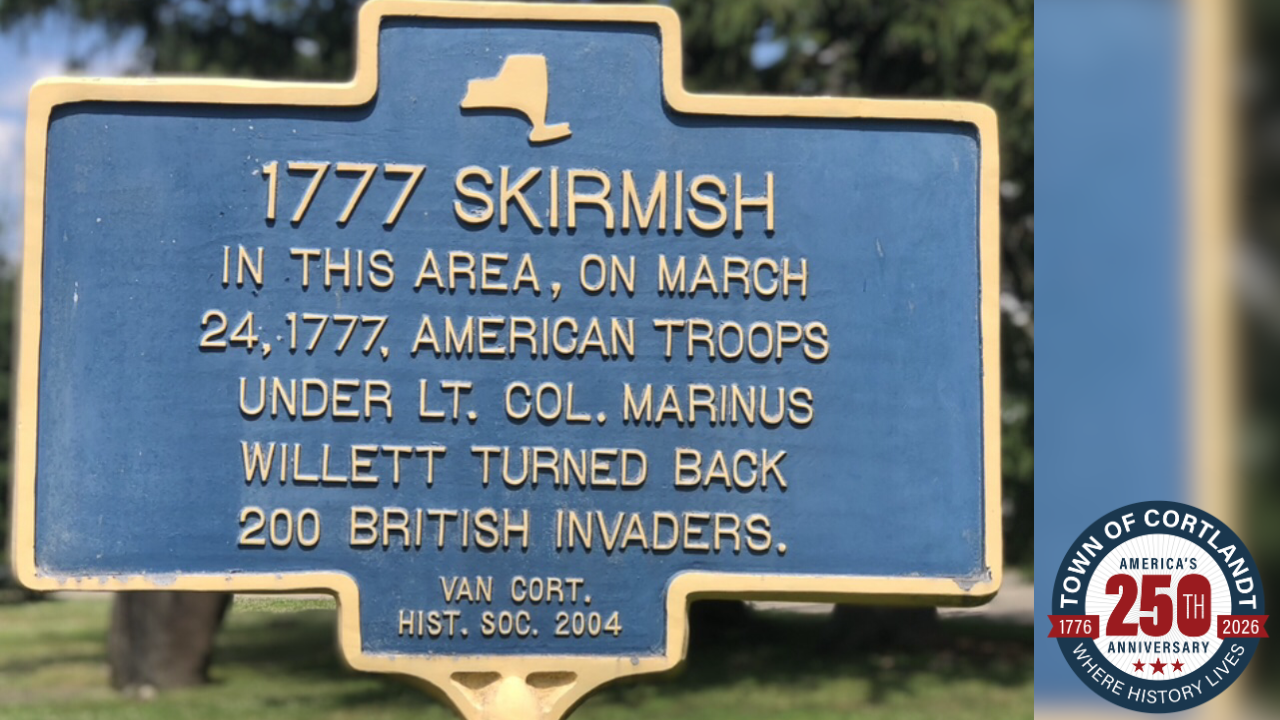
WHERE HISTORY LIVES PART 4: THE VAN CORTLANDTVILLE SKIRMISH OF MARCH 1777
Summary/Overview: The Van Cortlandtville Skirmish was fought on March 24, 1777 between American patriot troops commanded by Lt. Col. Marinus Willett and a British raiding party commanded by Lt. Col. John Bird in modern-day Cortlandt, during the American Revolutionary War. British troops marched up the Post Road (later known as Hillside Avenue and Oregon Road) to the Twin Hills, just south of the Van Cortlandt family’s Upper Manor House, where McDougall had posted an advance guard. The battle ended in American victory, with the British withdrawing back to their boats.
The Details: After being pushed out of New York City in 1776, George Washington established his headquarters in Peekskill along the Hudson River. He considered the area critical for keeping the Continental Army supplied. The British were well-aware, and in late March 1777, 500 British troops sailed up the Hudson River to raid Patriot farms and burn supplies. They landed at Peekskill Bay on March 23 and began pummeling Brig. Gen. Alexander McDougall‘s 250-man force on Fort Hill with artillery. Control of the Hudson River Valley was the linchpin between New England and the more southerly colonies, and the Hudson was the main street of New York. Washington considered this locale so important that it became a major assembly area for troops and militia as well as arms and supplies. The area was critical for the movement of men and materiel up and down the river, east into New England or west and south via the King’s Ferry between nearby Verplanck and Stony Point.
Washington’s worst fears were realized when in early 1777 the British sent a fleet of more than a dozen ships and smaller craft under the command of Col. Bird, to Peekskill, which had been established by Washington the previous November as the command post and headquarters for the Hudson Valley. Bird’s fleet appeared in Peekskill Bay around noon on Sunday, March 23 with 500 men. After burning a house owned by the Lent family the British troops marched up the Post Road and took up positions on Drum Hill, where they began firing at the settlement and the American positions on Fort Hill. Brig. Gen. Alexander McDougall, in charge of the 250-member American Highland Command, outnumbered 2-1, As the 500-man British forces advanced, they destroyed American barracks, workshops and storehouses. On Monday, March 24, the British troops marched up the Post Road (later known as Hillside Avenue and Oregon Road) to the Twin Hills, just south of the Van Cortlandt family’s Upper Manor House, where McDougall had posted an advance guard.
Meanwhile, American Colonial Willett led 80 men to join McDougall at the Gallows Hill barracks. There he observed a British detachment that was separated from the rest of the troops by a ravine, and he implored McDougall to attack them. While other Americans created a diversion to the west, Colonel Willet ordered his 80 men to fix bayonets and attacked the eastern flank of the British. Willett’s troops overwhelmed the British with the unexpected assault, sniping at them from behind trees and stone walls. Aided by darkness the British fled back to Fort Hill. After waiting for the full moon to rise, the entire invasion force retreated to its ships and sailed back to New York the next day. McDougall returned to Peekskill and reoccupied the Fort Hill redoubts and the settlement. Willett’s counterattack left nine British dead and four wounded. Four more British were killed while trying to burn American boats at Canopus Creek The colonel reported two men killed and four or five wounded.
McDougall wrote to George Washington: “…the Enemy fled with great precipitation to the main Body. They were panic struck, asserted the Woods were full of Rebel Soldiers.” The British slipped away in their boats the next morning. A few months later, at Van Cortlandtville, his men provided material for an early version of the U.S. flag, possibly its first use in battle.
-Richard H. Becker, M.D.
Supervisor,
Town of Cortlandt