Where History Lives: Part 14
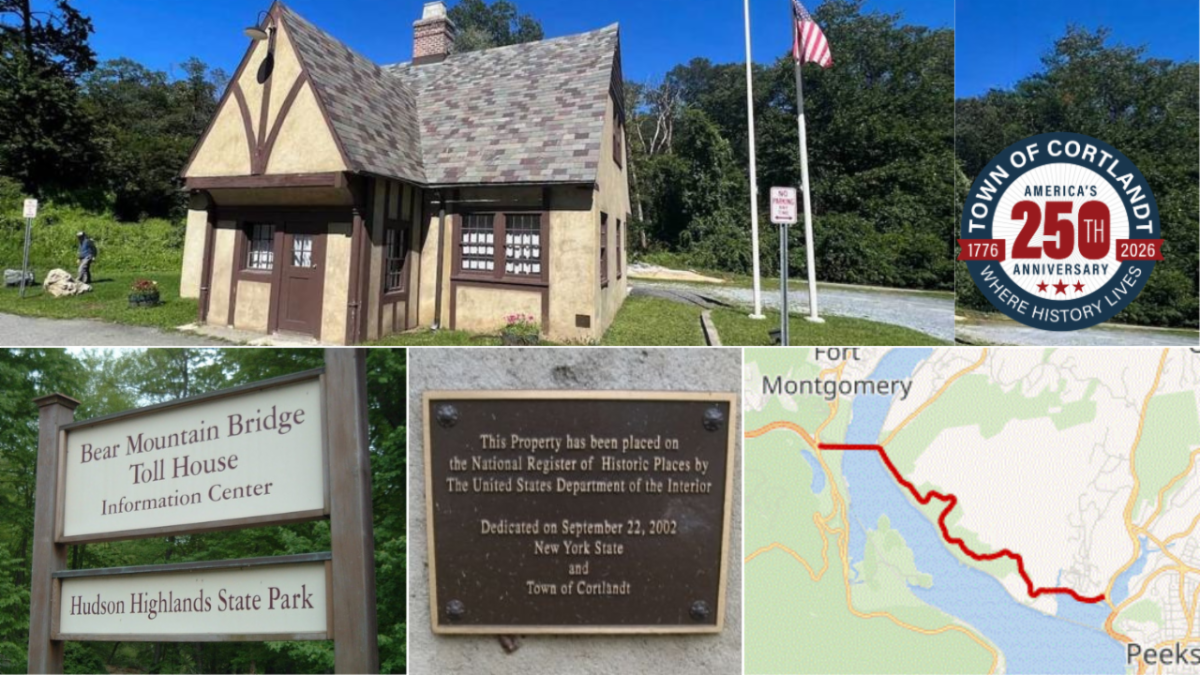
WHERE HISTORY LIVES PART 14: THE BEAR MOUNTAIN BRIDGE TOLL HOUSE (ANTHONY'S NOSE TRAIL HEAD)
FORMERLY SERVED THE BEAR MOUNTAIN BRIDGE
Plans for the bridge at the site began with the charter of the Hudson Highland Suspension Bridge Company in 1868. However, nothing really progressed due to the stock market crashes called the Panic of 1873 and Panic of 1893. In March 1922 the state legislature authorized creation of the private Bear Mountain Hudson River Bridge Company to complete the project. Under this 1922 charter, ownership of the bridge was to revert by 1962 to New York State. When the bridge formally opened on November 27, 1924, it was the longest suspension bridge span in the world. Ultimately, ownership was transferred earlier to the New York State Bridge Authority on September 26, 1940.
The Toll House: Opened in April 1925, now 101 years ago. The Bridge was privately owned and tolls were collected at the Bear Mountain Road Toll House. The tollhouse was utilized in the early days of the bridge to collect tolls from those who would be traveling on the road—regardless of whether or not the travelers were intending on utilizing the bridge. The Harriman family company was in charge of collecting tolls for the first thirty years The one-story Tudor-style Toll House has a gabled slate roof, exposed timbers, and smooth stucco finish. The west bay of the Toll House housed the office and collection area for tolls. It also served as the toll taker's residence.
In 1940, the Bridge and Road were sold to the State of New York. Under ownership of the State, collection of tolls at the Toll House ceased and the Bear Mountain Road Toll House was essentially left vacant. In 2002, The Town of Cortlandt restored the Toll House with a NYS grant from Governor Pataki, and Town of Cortlandt funds. The restored Toll House is used as a Tourist Information and Welcome Center. The Bear Mountain Bridge, Route 6/202 (Bear Mountain Bridge Road) and the Toll House are listed on the National Register of Historic Places in 1982 as part of the Hudson Highlands Multiple Resource listing.
The Toll House also serves as the trailhead for the Camp Smith Trail, a 2.5-mile hike that overlaps with the Appalachian Trail as it crosses the bridge and leads to the stunning vista of Anthony’s Nose at 900 ft. elevation at the South Gate of the Hudson Highlands. The Trail is moderately difficult, involving a steep staircase-like ascent (for about .6 miles), followed by a relatively flat stretch for .75 miles, and culminating at what you might call Anthony’s forehead, a gorgeous picnic-worthy rocky overlook with a spectacular view of the beautiful bridge below. The Toll House also serves hikers taking a popular trail along Anthony's Nose, through lands in the Camp Smith New York Army National Guard base just above the highway, to the Appalachian Trail just north of the bridge.
Visit the Toll House: view 75 archived images of the final construction of the BM Bridge, Rte. 9 roadway, as well as pictures of the Hudson Valley DayLiner, West Point Military Academy, the Harriman family, and the Hudson River Reserve Fleet of World War I and World War II. The hours of operation are 9 AM to 4 PM every weekend, from May to the end of October, including holidays. Local historian, Frank Goderre is your guide. A warm welcome awaits you.
Richard H. Becker, M.D.