Where History Lives: Part 18
WHERE HISTORY LIVES PART 18: the verplanck quarry
(The Town is indebted to Alan Morrison, Jr. who kindly provided this well researched historical information)
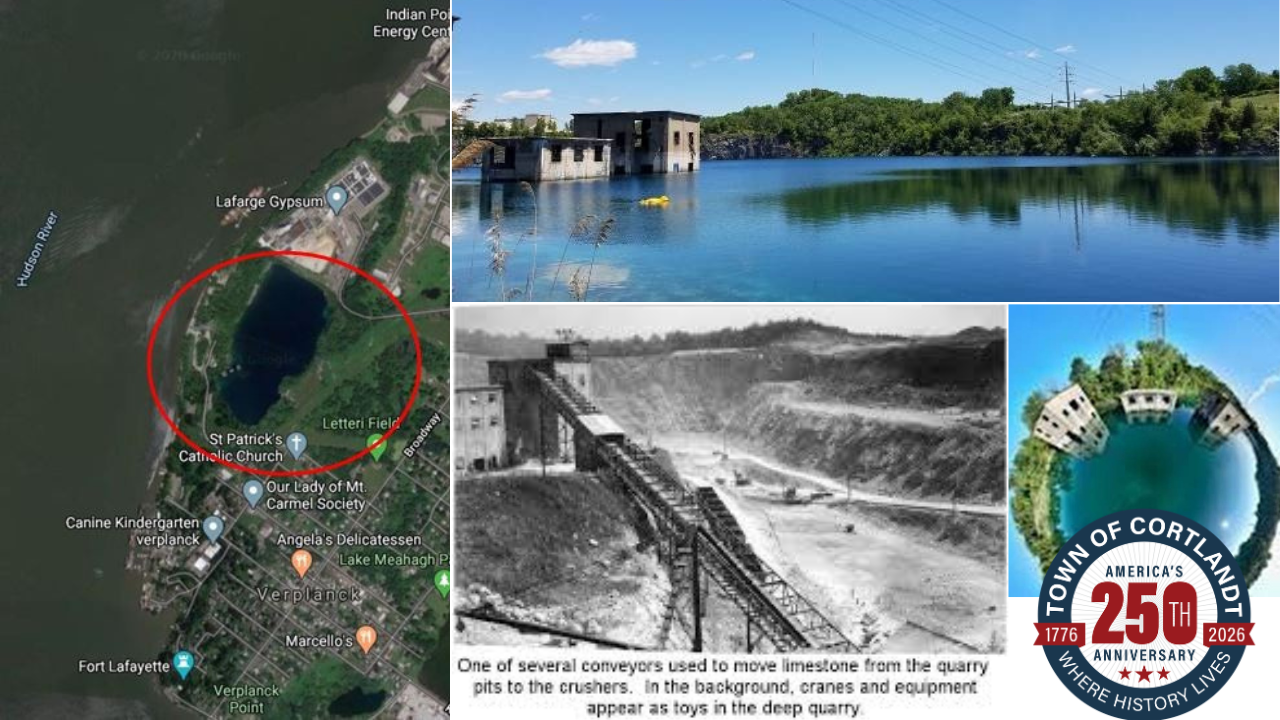
The Verplanck Quarry is a 99-acre parcel, now owned by the Town of Cortlandt, located along the Hudson River. It functioned as a limestone quarry, one of several in the area during the industrial era, with some of the infrastructure buildings remaining as concrete ruins.
The Quarry parcel was acquired from Con Edison by the Town in 2016, to prevent its acquisition by a private energy corporation. This parcel is historically significant and best known as the site of a limestone quarry (Verplanck Quarry). The Quarry operated from 1919 through 1956 by the New York Track Rock Corporation. Subsequently, after the plant ceased operations, water began flooding the quarry from an underground stream. This resulted in the creation of the 31.66 acre quarry pond with areas of varying depths some in excess of 150 feet. The quarry pond, with its beautiful turquoise waters, is a defining feature of the site and is surrounded by rock cliffs up to 80 feet high. Three concrete buildings related to the former quarry operation are partially submerged and located in the southwestern corner of the pond. Evidence of the former quarry operations remains scattered throughout the park, including two additional structures located west of the pond. The site also contains the remains of a fishery and electrical transmission lines.
Today, the silent quarry is owned by the Town of Cortlandt. Three abandoned ruins still protrude above the water, which remains clear and aquamarine blue. In an attempt to redevelop this site, a Quarry Committee of local residents and town officials was formed, but after several years of meetings, no development was approved. The town is now pursuing a "Quarry Conservancy Model", similar to that which is used for Central Park, the Highline, and Bryant Park in New York City. The hope is that this Conservancy will design, fund, and build a park of distinction, allowing for swimming in the quarry and other amenities. Preservation of the character of the community is always paramount.
Learn More:
Although not the name of a specific type of rock, one definition connects "trap" rock to a Dutch word meaning “steps”; Dutch miners thought that the excavation looked like a giant staircase.
The area became an active quarry in 1919, when the New York Track Rock Corporation began leasing the land. A diverse workforce was created from European immigrant workers from Italy, Croatia, Hungary, and Germany. The work was hazardous but the laborers were highly skilled and production skyrocketed. The process involved a series of boreholes, which were used to hold dynamite charges. When detonated, whole sections of the quarry wall were blasted away. Limestone rocks about the size of bowling balls were loaded by hand into wooden carts, mounted on tracks. The carts were towed by horse or donkey to large crushers, which processed the stones into gravel of various sizes. Limestone was then loaded by long conveyor belts onto barges. These were pushed and pulled by tugboats to construction sites throughout New York, as well as for the local use.
In 1923, the New York Trap Rock Corporation purchased the quarry from the Bleakley family for $750,000. However, shortly thereafter, on March 19, 1924 there was a disastrous fire. The fire was discovered just before midnight, and many Verplanck Quarry workers responded. The Verplanck fire department had not yet been formed, and so the Peekskill fire department was summoned. Unfortunately all the buildings that the quarry were lost and efforts were directed at protecting office buildings, stables, and local homes. All of the buildings, machinery, and equipment were destroyed. Fortunately, the company decided to rebuild, including new equipment with installation of more efficient stone crushers and conveyor belts. Electric powered courts replace the horse driven ones previously used. In addition, modern Steve troubles were brought in for excavation and to load the carts. Nearly hundred 20 men were employed at the newly rebuilt quarry in production continue to increase as did the profits to the company.
The Great Depression of the 1930s devastated the American economy but Roosevelt's Works Progress Administration led to many municipal construction and road improvements projects. These kept the quarry very busy.
Unionization of labor began, and in 1938 ballots from workers were counted at the garage at the Rectory of St. Patrick's Church and it was decided that the AFL would represent the union. During World War II, there was little ongoing construction and in March 1943 the decision was made to shut down the Verplanck Quarry until the end of the war. It reopened briefly in 1945, but with a substantially reduced workforce. The quarry continued operations until the mid-1950s, when the plant was operating at a loss. On March 19, 1956 The Trap Rock Corporation announced it would cease operation at the end of the year. After 75 years of operation, the Verplanck Quarry ceased operation. When the water pumps were shut down, 300,000 gallons/day of water that had been pumped out of the quarry now collected, filling the quarry with clear and clean water. This is how it continues to exist today.