Where History Lives: Part 24
WHERE HISTORY LIVES PART 24: tHE AARON COPLAND HOUSE
Aaron Copland (November 14, 1900 – December 2, 1990) was an American composer, critic, writer, teacher, pianist, and conductor of his own and other American music. Copland was referred to by his peers and critics as the "Dean of American Music". He is best known for the works he wrote in the 1930s and 1940s in a deliberately "populist" style. Works in this vein include the ballets Appalachian Spring, Billy the Kid and Rodeo, Fanfare for the Common Man and Third Symphony. Importantly, Fanfare for the Common Man (https://www.youtube.com/watch?v=HKgk6G0lekQ&t=11s) became a patriotic anthem.
It was commissioned by the Cincinnati Symphony Orchestra in 1942, shortly after the United States entered World War II, to inspire audiences and pay tribute to the war effort. In addition to his ballets and orchestral works, he produced music in many other genres, including chamber music, vocal works, opera, and film scores
In 1964, Aaron Copland was presented with the Presidential Medal of Freedom for his contributions. The citation read, “Masterful composer and gifted teacher, his music echoes our American experience and speaks expressively to an international audience.” In 1979, he was recognized as part of the second-ever Kennedy Center Honors. Following his death in 1990, the popularity of Copland’s music continued undiminished. In 2025, the 125th anniversary of Copland’s birth was marked by performances of his music across the world—introducing new audiences to the spirit of American music.
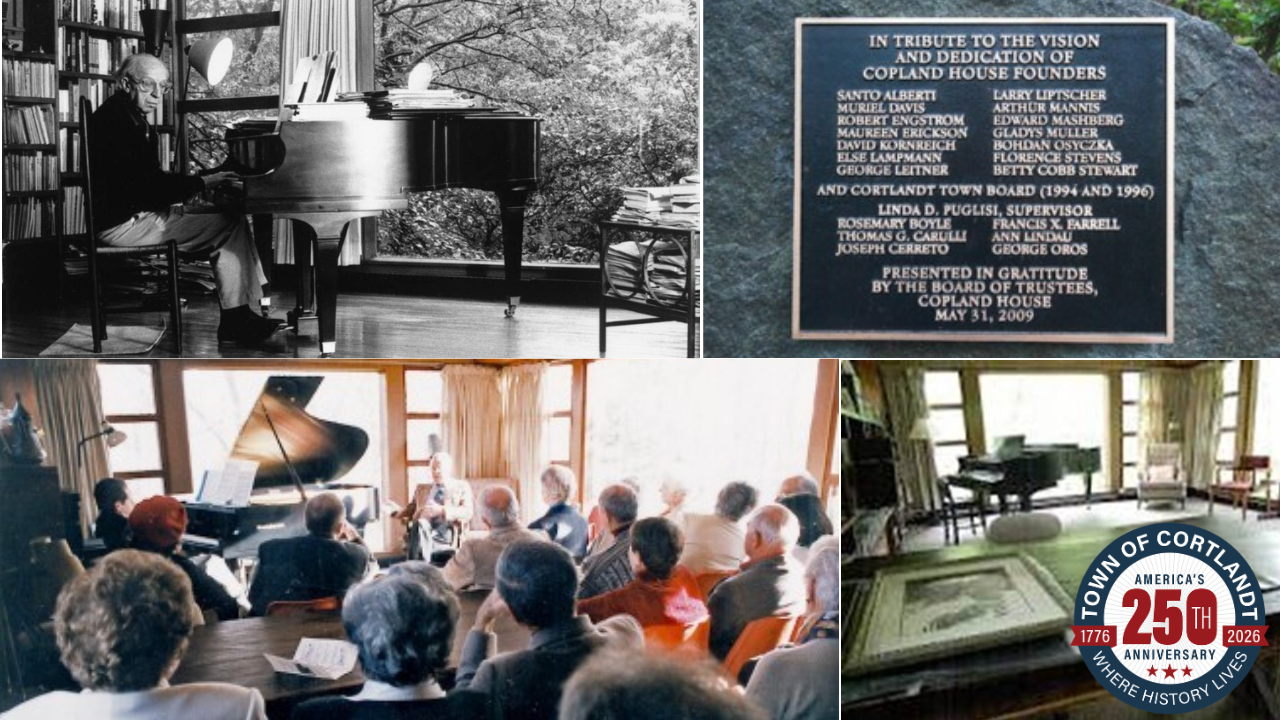
The Aaron Copland House, also known as Rock Hill or Copland House, is the former home of composer Aaron Copland for the last 30 years of his life, and now also a creative center for American music. Located on Washington Street in Cortlandt Manor, and built in the 1940s. The house and its garage were listed on the National Register of Historic Places in 2003, and five years later, in 2008, they were designated a National Historic Landmark, the only one in the country connected to a figure from the world of classical music. The grounds below Copland's home consist of a two-tiered garden ringed by natural woods, and in 2009, the National Wildlife Federation designated the property a Certified Wildlife Habitat.
Its composer-in-residence program, known as the Copland House Residency Awards, began in November 1998. It awards six to nine emerging or mid-career American composers the opportunity to work and reside, one at a time, at Rock Hill. Composers who apply and are approved, are afforded three-to-eight-week stays in the house, with an allowance for food and the use of a car, while they work
Copland House is the recipient of Arts Westchester’s 2010 Arts Award for its “important contribution to the growth of Westchester’s cultural life,” Westchester magazine’s 2010 “Best of Westchester” award for “classical inspiration,” and the American Music Center’s 2011 Letter of Distinction for its “significant contribution to the field of contemporary American music.”
LEARN MORE: On a rocky hill atop three acres of woodland in the lower Hudson River Valley hamlet of Cortlandt Manor, less than one hour north of New York City, is “a dwelling of particular historical interest” (The New York Post) – the home where Aaron Copland, one of the most celebrated and profoundly influential musical figures in American history, lived and worked for the last thirty years of his life (from 1960 to 1990). The prairie-style home is spacious yet unassuming, and reflects Copland's rugged elegance and natural dignity. The Copland House is the only composer’s home in the United States devoted to nurturing and renewing America’s rich musical heritage through a broad range of activities
A few years after Copland's death in 1990, a coalition of local townspeople launched a genuine grassroots movement to preserve and restore this historic residence as the living, enduring embodiment of his seminal artistic and personal legacies and lifelong advocacy of American composers. Following extensive physical renovations, Copland House became operational in 1998 as a 501(c)3, not-for-profit creative center for American music, built upon three core programmatic pillars. Its support for composers includes coveted, all-expenses-paid residencies; post-residency awards and performances that further advance their work; fiscal sponsorships; and composer commissions. Its public programs include concerts throughout the U. S. by its touring resident Music from Copland House ensemble, as well as recordings, broadcasts, and Webcasts; film screenings and visual exhibitions;
All programs and activities are supported by the tax-deductible contributions of the broad-based, nationwide Friends of Copland House. The noted pianist and recording artist Michael Boriskin was appointed Artistic Director of Copland House in 1998, and became Artistic and Executive Director in 2003.
-Richard H. Becker, MD
Town Supervisor